Showing posts with label Neologism. Show all posts

Aforeimplemented: Illustrated via the Great Cookie Treaty Scandal

Aforeimplemented

English

Katakana: アフォアインプリメンテッド

Part of Speech: adjective

Definition: Previously implemented; carried out or put into practice earlier, especially in reference to something already mentioned in a text or discussion.

Example Sentence: “According to the aforeimplemented snack protocol, all cookies must be shared equally, except with Dave, who already violated the treaty by eating six during negotiations.”

Origin: Formed by combining afore meaning “before” and implemented meaning “put into practice.”

Related Terms: aforementioned, aforecited, aforenoted, preestablished

Defining “Pooaboo”: When Fecal Curiosity Becomes Obsession

Pooaboo

English

Part of Speech: |  IPA (Approx.): /ˈpuːəˌbuː/

Katakana: プーアブー

“A person who becomes unusually or excessively obsessed with studying fecal matter.”


Definition 1:
A person who becomes unusually or excessively obsessed with studying fecal matter, often working in fields such as microbiology, gastroenterology, or nutrition research.

Quick Study Definition:
Someone obsessed with analyzing or researching fecal matter.


Example Sentence:
She started as a microbiologist, but after her third grant on gut bacteria, she turned into a total pooaboo.


Etymology:

  • poo: informal term for feces
  • -aboo: playful slang suffix indicating exaggerated fixation, patterned after weeaboo

Literal Meaning:
One who is fixated on fecal matter.


Related Terms:

  • Weeaboo — Westerner obsessed with Japanese culture
  • Koreaboo — non-Korean obsessed with Korean culture
  • Coprology — the study of feces (formal)
  • Microbiome research — scientific study of gut bacteria

Westaboo (n.): A Non-Westerner Obsessed With Western Culture

Westaboo

English

Part of Speech: |  IPA (Approx.): /ˈwɛstəbuː/

Katakana: ウェスタブー

“A non-Westerner who idealizes and fixates on Western culture.”


Definition 1:
A non-Western person, often a Japanese national, who becomes intensely fixated on Western culture, aesthetics, or media, usually in a romanticized or unrealistic way.

Definition 2:
Someone who idealizes Western culture beyond reason or reality.

Quick Study Definition:
A non-Westerner obsessed with Western culture.


Example Sentence:
After spending a semester abroad in California he returned quoting sitcoms and eating burgers for every meal and his friends teased him for becoming a full westaboo.


Etymology:

  • west: relating to Western countries or culture
  • -aboo: slang suffix indicating exaggerated cultural fixation, patterned after weeaboo

Literal Meaning:
One who is fixated on the West.


Related Terms:

  • Weeaboo — Westerner obsessed with Japanese culture
  • Koreaboo — non-Korean obsessed with Korean culture
  • Occidentophilia — love of Western culture (formal)
  • Cultural fixation slang — terms marking exaggerated fandom of other cultures

Naming the Machine: Capitalopoiesis and the Production of Value

Capitalopoiesis

English

Part of Speech: |  IPA (RP & GenAm): /ˌkæp.ɪ.tə.ləʊˈpɔɪ.i.sɪs/

Rhymes: -poiesis

“The process of creating or producing capital.”


Definition:
1. The process by which individuals, through purposeful action and entrepreneurial judgment, create and expand capital based on subjective value and market coordination.


Usage:
Used in academic, sociological, and philosophical contexts to describe how various forms of capital are generated and maintained through ongoing processes or systems.

Etymology:
From Latin capitalis (“of the head; relating to wealth or assets”) + Greek -poiesis (“making, creation”). A modern hybrid neologism modeled after terms like autopoiesis, denoting systemic or organic production.

Sentence Example:
In the digital age, identity becomes a site of capitalopoiesis, as self-expression is reconfigured into a mechanism for economic and social value creation.


Idiofacient — The Doer of Distinctive Deeds

Idiofacient

English

Part of Speech: |  IPA (RP & GenAm): /ˌɪdi.oʊˈfeɪʃənt/

Rhymes: -facient

“One who acts or creates in a distinctly personal way.”


Definition:
(adj.) Characterized by creating or acting in a uniquely personal or idiosyncratic way; marked by one’s own distinctive style.
(n.) A person who habitually acts or creates in a distinctively personal or idiosyncratic manner.

adjective
Causing the expression or production of a uniquely personal or idiosyncratic style; bringing about something marked by one’s own distinctive character.
Example: Her idiofacient brushwork gave the canvas a signature that no other artist could reproduce.

noun
A person or agent that causes or brings about a distinctively personal or idiosyncratic effect.
Example: As an idiofacient, he reshaped the movement with techniques that no one else dared attempt.

Usage:
Often used to describe artists, inventors, or thinkers whose methods or expressions are highly individualized.

Etymology:
From Greek idios (“own, personal, peculiar”) + Latin facere (“to do, to make”). Coined as a neologism to describe distinctively personal action or creation.

Example (conversational):
"Her idiofacient approach to painting made every piece immediately recognizable."
"As an idiofacient, he refused to follow conventional methods, preferring his own innovative techniques."


See Also: Eccentricity | Individualism | Originality


Brachymisandrist: Swiping Left on the Vertically Challenged

Brachymisandrist

English

Part of Speech: |  IPA (RP & GenAm): /ˌbræk.i.mɪˈsænd.rɪst/

Rhymes: -ist

“One who looks down on men of lesser height.”


Definition:
A woman (or person) who harbors a dislike, aversion, or prejudice specifically toward short men.

Usage:
Sometimes employed in humorous, satirical, or critical contexts when discussing biases in dating preferences or social perceptions of masculinity.

Etymology:
From Greek brachys (“short”) + misandrist (“one who dislikes or is prejudiced against men”). Coined as a neologism to describe height-specific prejudice against men.

Example (conversational):
"She swiped left immediately — turns out she’s quite the brachymisandrist."


See Also: Misandry | Height Discrimination |


That One Time It Was Right: On the Errant Chronoveridic Interval

The Errant Chronoveridic Interval

Noun Phrase |  /ˈɛɹ.ənt ˌkɹoʊ.noʊˈvɛɹ.ɪ.dɪk ˈɪn.tə.vəl/

エラント・クロノヴェリディック・インターバル

“When even the nonsense gets a turn.”


Definition

A rare, ironic moment in which a typically false, flawed, or absurd idea briefly appears or is correct—entirely due to the cyclical or coincidental nature of time. Often used to describe situations where broken logic, faulty predictions, or pseudoscience gain momentary validation.


Etymology

From errant (Latin errare, “to wander” or “go astray”), referring to something misguided or incorrect; chronoveridic (a neologism from Greek chronos, “time” + Latin veridicus, “truth-speaking”); and interval (Latin intervallum, “space between”), meaning a measurable moment in time.


Usage

  • His blog entered an errant chronoveridic interval—wrong for years, right for a week.
  • The YouTuber’s wild theory enjoyed an errant chronoveridic interval after a headline vaguely aligned with it.
  • That prediction was no prophecy—it was an errant chronoveridic interval, nothing more.

Utilized Terms

  • Errant — mistaken or straying from the proper course; derived from Latin errare.
  • Chronoveridic — a neologism meaning “truthful by virtue of cyclical time”; from Greek chronos + Latin veridicus.
  • Interval — a measurable space or period between events; from Latin intervallum.

Symbolic Associations

Often used in ironic, comedic, or philosophical commentary on falsehoods that gain temporary credibility. Invoked in internet culture, fortune-telling, broken systems, and “doomsday” predictions that momentarily seem valid.


Contextual Note

The phrase is inspired by the logic behind the saying, “Even a broken clock is right twice a day.” A popular variation sometimes quoted as: “A broken clock is right 730 times a year.”
While this line is often attributed to The X-Files, there is no verified record of it appearing in any official script or episode. Instead, it’s a playful exaggeration rooted in time math:

A broken analog clock—stuck at a fixed time (e.g., 6:30)—will display the correct time twice per day:
2 times/day × 365 days/year = 730 instances of “accidental truth” per year.


Katakana Breakdown

  • エラント (eranto) — “errant,” mistaken, wayward
  • クロノ (kurono) — from “chronos,” time
  • ヴェリディック (veridikku) — “veridic,” truth-telling
  • インターバル (intābaru) — interval, time window

Stains That Stay: Defining Indelvestent

Indelvestent

Adjective | /ˌɪn.dɛlˈvɛs.tənt/

インデルヴェステント


Definition

Describing a stain, blemish, or trace—whether physical, emotional, or symbolic—that resists all efforts of removal. It remains embedded, persistent, and unerasable despite cleansing, concealment, or the passage of time.

Possibly a screengrab from the manga Gintama. Source unconfirmed.


Etymology

From the Latin prefix in- (“not”) + del- (from delere, “to erase”) + an invented root vest- (echoing vestis, “garment,” and vestige, “trace”) + the suffix -ent (denoting a persistent adjectival state). Thus, indelvestent suggests “that which cannot be unmarked or divested.”


Usage

  • The wine left an indelvestent blot on her grandmother’s lace veil—an heirloom now baptized by memory.
  • His words were indelvestent, etched deeper than he could ever recall or retract.
  • The scandal was no mere blemish; it was indelvestent—woven into the fabric of his reputation.

Related Terms

  • Indelible — incapable of being removed or forgotten
  • Vestigial — lingering as a trace of something lost or fading
  • Scaevity — ill-fated or marked by bad luck (rare)

Symbolic Associations

Often used to describe emotional impressions, moral stains, or metaphysical taints—particularly in poetic or Gothic literature. A sister word to memento in tone, but darker in implication.


Phonetic Breakdown (Katakana)

  • イン (in) — from Latin “in-,” meaning "not"
  • デル (del) — from “delere,” meaning "to erase"
  • ヴェス (ves) — stylized from “vestis” or “vestige”
  • テント (tent) — from “-ent,” forming an adjective

Personadaedalist — The Master Crafter of Personas

Personadaedalist

(noun) | /ˌpɜːrsəˈnædəˌlɪst/

/パーソナデアダリスト/


Definition

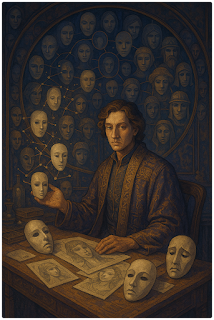
A person who skillfully crafts, invents, or fabricates complex personas or identities—whether real, fictional, or symbolic—with the precision and artistry reminiscent of a master artisan. Often involved in psychologically or artistically constructing layered characters, masks, or social facades.

Illustration of a Personadaedalist

Etymology

From Latin persona (“character,” “mask”) + Greek mythological figure Daedalus (renowned craftsman and inventor) + English suffix -ist (denoting an agent or practitioner).

Example Sentence

The novelist was a true personadaedalist, weaving intricate personalities so vivid they seemed to leap off the page.

Connotative Note

The term often carries an artistic or psychological nuance, highlighting not just the act of creating personas but doing so with exceptional creativity and craft, whether for storytelling, performance, social navigation, or self-expression.

Katakana Pronunciation Breakdown

Personadaedalist → パーソナデアダリスト

  • Per → パー
  • so → ソ
  • na → ナ
  • dae → デア
  • da → ダ
  • list → リスト

Personifacture: The Fiction We Project Onto Machines

Personifacture
(noun)
/ˌpɜːrsəˈnɪfæktʃər/

/パーソニファクチャー/

Definition:
The active or habitual process of mentally crafting or constructing personality traits, intentions, or emotional states onto inanimate objects—treating them as if they possess a character or will of their own.

Connotative Note:
Often associated with individuals exploring panpsychism or animism for the first time, delighting in “manufacturing” personalities for household objects. It also describes the tendency to idealize significant others by projecting personality traits they may not genuinely possess, sometimes elevating them onto a pedestal. This phenomenon resonates with Shintoist sensibilities, which perceive kami (spirits) inhabiting natural and man-made objects, thus fostering a worldview where personifacture becomes a natural expression of relational respect and interconnectedness.

Etymology:
From person- (Latin persona, “character”) + facture (from Latin factura, “a making” or “fashioning”).

Example sentence:
After his laptop crashed for the third time that day, James accused it of betrayal in a moment of pure personifacture.

Cultural reference:
This phenomenon is humorously captured in a Facebook video where a balloon appears to take on a mischievous personality as a man waits for the subway.

Subway Creatures. 2024. “A balloon takes on a life of its own during a subway ride.” Facebook video, June 3. https://www.facebook.com/reel/1197388865148265

Distinctions from Related Terms:

  • Personification: A literary or rhetorical device where human qualities are attributed to animals, objects, or abstract concepts, often for metaphorical or artistic effect. It is typically intentional and symbolic, used primarily in storytelling or poetry.
  • Personify: The verb form of personification; to represent or embody something as a person or with human characteristics, usually in a deliberate or creative context.
  • Personifacture: Unlike personification, personifacture emphasizes the psychological or habitual act of mentally crafting or projecting personalities onto inanimate objects, often unconsciously. It involves an active "manufacturing" of character traits, sometimes linked to emotional needs, belief systems (such as panpsychism or animism), or interpersonal idealization. It is less about metaphor and more about a genuine or semi-genuine attribution of personality or will, blending cognition and emotional projection.

Katakana Pronunciation Breakdown:
Personifacture → パーソニファクチャー

  • Per → パー
  • soni → ソニ
  • fac → ファク
  • ture → チャー

Further Reading:

Barkour: The Art of Canine Parkour

Barkour

Noun | /ˈbɑː(r).kʊə(r)/

ბარკურ

[Modern neologism • Humorous slang]


Definition

A canine movement discipline in which dogs traverse their environment by running, jumping, climbing, scrambling, leaping, or performing other physical actions to navigate obstacles in a fluid or determined manner.

Usage

“When Caninus Maximus launched himself from the couch to the kitchen counter in a single bound—mid-spin and knocking over a plant—we realized he’d entered full barkour mode.”

Etymology

Formed as a blend of bark (the sound a dog makes) and parkour (a movement discipline based on navigating obstacles, from French parcours, meaning “route” or “course”).

Related Media

Barkour in Action: Watch a high-energy dog tear through a homemade agility course, complete with dramatic slow motion and the soundtrack of Bonnie Tyler’s “Holding Out for a Hero.” Equal parts action movie and pet chaos.

Video clip from @parkour.ninja on Instagram, posted May 25, 2024. Audio includes “Holding Out for a Hero” by Bonnie Tyler. Shared here under fair use for cultural and linguistic commentary.

🐾 Sadaharu: Gintama’s Barkour Enthusiast

Sadaharu, the massive white-furred dog from Gintama, is a prime example of barkour in action. Despite his size, he exhibits remarkable agility—leaping across rooftops, bounding through alleyways, and navigating obstacles with surprising ease. His energetic movements and playful nature make him a standout character in the series.

For more about Sadaharu and his adventures, check out the Gintama anime on MyAnimeList.

Georgian Transliteration Pronunciation Breakdown

The Georgian script rendering ბარკურ approximates the English pronunciation of “Barkour” using native Georgian phonetics:

  • ბ (b) – voiced bilabial stop, as in boy
  • ა (a) – open front vowel, like the “a” in father
  • რ (r) – trilled or tapped “r” sound
  • კ (k) – voiceless velar stop, like the “k” in kick
  • უ (u) – close back rounded vowel, like the “oo” in cool
  • რ (r) – trilled “r” again

Put together, ბარკურ is pronounced approximately as bar-KOOR in English, preserving the humor and rhythm of the original coinage while adapting it to the elegant Georgian script.

Spell: IGNIPLUVIATE // [Rain: Burning]

Ignipluviate (verb)

Pronunciation: /ˌɪɡ.nɪˈpluː.vi.eɪt/

Katakana Transliteration: イグニプルヴィエイト

Inflected forms: ignipluviates, ignipluviated, ignipluviating


Definitions:

  1. Literal / Surreal:
       To set rain on fire; to ignite falling water through supernatural or physically impossible means.

    “The mage lifted her hand, and the storm ignipluviated above them, raining fire from the sky.”

  2. Poetic / Emotional:
       To emotionally combust; to experience a violent inner collision of passion and sorrow, especially in the context of love, heartbreak, or betrayal.

    “In that moment, holding his lies and her longing, she ignipluviated—burning her tears before they hit the ground.”


Etymology:

From Latin ignis (“fire”) + pluvia (“rain”) + the English verb-forming suffix -ate. Inspired by the imagery in Adele’s 2011 ballad Set Fire to the Rain, where fire and rain symbolize conflicting emotional states.


Cultural Note:

The phrase “set fire to the rain” has come to represent emotional contradiction—where desire and pain coexist. Ignipluviate captures this paradox: passion scorching through grief, and the impossibility of resolving love’s contradictions without destruction.


Quixote with a Cooler: Defining the Beer-Errant

beer-errant

Noun / Adjective | /ˈbɪəɹ ˌɛɹənt/

ბირ-ერანტ

[modern neologism • mock-chivalric slang]


Definition

As a noun: A person who engages in quixotic conduct involving beer.
As an adjective: Describing bold, impractical, or idealistic behavior involving beer.

Etymology

From beer + errant (as in knight-errant, from Latin errare, “to wander”).

Example Sentences

  • Everyone else stayed home and watched the news—he went full beer-errant and flew into a war zone with nothing but a duffel bag and a case of Pabst.
  • There’s a fine line between bravery and being a beer-errant, and Chickie danced on it with every step through Vietnam.
  • They called him a fool, but every beer-errant starts with someone saying it can’t be done.
  • To be a beer-errant is to mistake sentiment for strategy—and do it anyway, grinning.
  • It was a beer-errant scheme from the start: a map drawn on a napkin, a borrowed truck, and a promise made in a bar.
  • The whole trip was beer-errant in nature—no plan, just beer, blind optimism, and a vague sense of purpose.
  • He made a beer-errant vow to show up for every friend who ever bought him a drink, no matter the distance.
  • His beer-errant logic was simple: if you care enough, you bring the beer in person—even to a battlefield.

The Greatest Beer Run Ever and the Beer-Errant Archetype

The Greatest Beer Run Ever (2022) is perhaps the most literal and sincere cinematic expression of the beer-errant: a figure who undertakes a quixotic journey involving beer, driven more by emotion than logic.

John “Chickie” Donohue’s decision to carry a duffel bag of Pabst Blue Ribbon into an active war zone reflects the core spirit of the term—bold, impractical, deeply personal, and rooted in misguided idealism.

Chickie’s beer-errantry is not heroic in the traditional sense. It lacks clear purpose, rational planning, or even consent from its intended recipients. What it possesses instead is raw sincerity: the belief that sharing a beer might bridge the gulf between home and war, civilian and soldier, life and death.

Rather than parody, the film offers a straight-faced case study: a person whose symbolic gesture, however absurd, becomes a vehicle for transformation. Chickie does not return triumphant, but altered—having followed through on a ridiculous mission only to discover something real beneath it.

The Greatest Beer Run Ever (2022) film poster

Image credit: Film poster. Used under fair use for commentary and critical analysis.

beer-errant in The World’s End (2013)

The term beer-errant finds a natural embodiment in Gary King, the central figure of The World’s End. His doomed determination to complete the “Golden Mile”—a 12-pub crawl in his hometown—is a textbook act of beer-errantry: impractical, emotionally loaded, and carried out with a blend of nostalgia, denial, and misplaced heroism.

Though framed around beer, Gary’s journey is not about drinking per se, but about restoring a lost sense of self through ritualized excess. Like a knight-errant clinging to a code no longer relevant, the beer-errant clings to old narratives in defiance of present reality.

In this way, The World’s End functions as a darkly comedic case study of beer-errantry pushed to its limit—where the quest persists even when the world around it no longer exists.

The World's End (2013) film poster

Image credit: Film poster. Used under fair use for commentary and critical analysis.

Note: The term knight-errant derives from Old French chevalier errant, or “wandering knight.” It forms the linguistic and thematic foundation of beer-errant, preserving the idea of a quest driven by personal myth, but substituting beer for chivalry.

Related Terms

  • Pot-valiancy
    Noun — Bravery or boldness brought on by drunkenness, especially of the foolish or reckless sort.
    “He charged into the argument with pure pot-valiancy and no facts whatsoever.”
  • Liquid courage
    Colloquial Noun — Confidence gained from alcohol, usually temporary and unreliable.
    “He only talked to his crush after a shot of liquid courage.”
  • Quixoticism
    Noun — Behavior driven by impractical idealism, especially when detached from reality.
    “His plan to fix everything with one grand gesture reeked of quixoticism.”

References and Citations

How to Sound Smart While Selling Out: Quaestuary

Quaestuary

Adjective | /ˈkwes.tjuː.ɛr.i/ or /ˈkwiː.stjʊə.ri/
[rare • rhetorical • economically inclined]

ᚳᚹᚪᛖᛋᛏᚢᚪᚱᛁᛃ


Definition

Relating to the pursuit of gain, particularly monetary; preoccupied with profit or mercantile advantage. Describes an orientation—personal, institutional, or ideological—toward acquisition rather than aspiration.


Etymology

From Middle French questuaire, via Late Latin quaestuarius (“pertaining to gain or profit”), from Latin quaestus (“gain, profit”), the past participle of quaerere—“to seek, ask, or strive.”
This root also gives us question, inquiry, and quest—suggesting that even noble searches may trace back to material motives.
The noun form questuarius (Medieval Latin) referred to one who collects alms—where spirituality met structured gain.

Synonyms:

acquisitive, mercantile, profit-minded, pecuniary

Antonyms:

disinterested, idealistic, altruistic, mission-driven


Lexical Mood

A term that jingles with coin while quoting Cicero—where moneymaking wears the mask of virtue.

Smithian Sidebar

In The Theory of Moral Sentiments (1759), Adam Smith critiques the social instinct to admire wealth not for its utility, but as a stand-in for moral virtue. His observation cuts straight to the heart of quaestuary behavior—where profit is pursued not just shamelessly, but sanctimoniously.

Usage Examples for quaestuary:

“They spoke of liberty, but their actions were firmly quaestuary—freedom, for a fee.”
“The quaestuary class have the media in their pockets, and the public in their palm.”
“Beneath the philanthropy was a quaestuary calculus—where moral gestures masked financial maneuvers.”
“It was a quaestuary age—every virtue had a price tag, every value a valuation.”
“Even the revolutionaries had sponsors—quaestuary motives stitched beneath their slogans.”

Further Reading & Recommendations

Breakdown of the Runes

Here's a transliteration of your runes:

Rune Latin Letter Name Meaning
ᚳc/kCēnTorch
ᚹwWynnJoy
ᚪaĀscAsh tree
ᛖeĒohYew tree
ᛋsSigelSun
ᛏtTīrHonor, the god Tiw
ᚢuŪrAurochs (wild ox)
ᚪaĀscAsh tree
ᚱrRādRide, journey
ᛁiĪsIce
ᛃj/yJēraYear, harvest

Transliterated Result

c-w-a-e-s-t-u-a-r-i-j
Which matches the phonetic components of quaestuary as best as possible using Anglo-Saxon runes.

Note: Anglo-Saxon doesn’t have a perfect 1:1 mapping with Latin/modern English letters, so substitutions like ᛃ for "y/j" and ᚳ for "q/c/k" are the best-approximated forms available in the script.

Where Green Lingers: The Mood of Chlorisma

Chlorisma

noun | /ˈklɔː.rɪz.mə/
ᚳᛚᚩ·ᚱᛁᛉ·ᛗᚪ


Etymology:

From Greek khlōrós (green, fresh) + -isma (Greek suffix denoting an act, process, or impression).


Definition:

1. The quiet emotional or sensory imprint left by reflective contact with cultivated plant life, especially in moments of stillness or introspection.
2. A subtle, wordless experience of peace or memory triggered by the presence of gentle greenery—ritual-like solitude within an atmosphere of botanical grace.


Usage:

Even in silence, the olive grove spoke in chlorisma—rooted, fragrant, and known only by stillness.


Rune Transliteration Notes:

  • ᚳ = c/k (as in “klo”)
  • ᛚ = l
  • ᚩ = o (long “o”)
  • ᚱ = r
  • ᛁ = i
  • ᛉ = z/x (used here to suggest the /z/ in "riz")
  • ᛗ = m
  • ᚪ = a (as in “sofa”)

This form treats the runes as a phonetic mirror of the IPA pronunciation—not a literal letter-for-letter rendering.

Ignipotent Defined — Fire, Power, and Prominence Burn

Ignipotent

Adjective

Pronunciation: /ˌɪɡ.nɪˈpoʊ.tənt/

イグニポテント

[fiery • having control over fire]


Definition

Ignipotent describes someone or something fiery, or possessing power over fire.

Illustration for ignipotent

Example

In My Hero Academia, Season 4, Episode 25, the ignipotent hero Endeavor uses his ultimate technique, Prominence Burn—a massive, concentrated inferno—delivered point-blank as he pushes past his own injuries and exhaustion, vaporizing the Nomu in the sky.

Etymology

From Latin ignis ("fire") + potent ("powerful")

Episode citation:
My Hero Academia, Season 4, Episode 25: "His Start"
Originally aired April 4, 2020. Directed by Kenji Nagasaki. Written by Yōsuke Kuroda. Produced by Studio Bones.

Optical Juggle: The Politics of Looking Honest

Optical Juggle

Noun Phrase  |  /ˈɒp.tɪ.kəl ˈdʒʌɡ.əl/

ᚩᛈᛏᛁᚳᚪᛚ · ᛡᚢᚷᚷᛚ

[modern rhetorical neologism]


Definition

Optical juggle refers to the artful and deceptive practice of strategically managing information to create a misleading perception of correctness or credibility. It often involves rhetorical misdirection, narrative manipulation, and selective emphasis—especially in debates conducted in bad faith.

Usage

More broadly, the term encompasses a spectrum of subtle deceptions, including the selective presentation of facts, strategic ambiguity, and nuanced framing. The aim is to shape perception in one's favor without necessarily resorting to direct falsehoods.

Example

"The political strategist excelled in optical juggling, crafting a narrative that, while not relying on explicit falsehoods, cleverly presented information to create a distorted yet seemingly accurate perception in the minds of voters."
A magician visually juggling perception and reality

Related Terms

  • Perception Management: The deliberate shaping or influencing of public perception through strategic communication techniques.
  • Strategic Ambiguity: The intentional use of vague or ambiguous language to guide interpretation without committing to a fixed meaning.
  • Misleading Truths: Truthful statements used in a way that creates a false impression. As discussed in Michael Sandel’s lecture on Kantian ethics, such statements may technically adhere to honesty while violating the spirit of truth. They “pay homage to duty” yet serve deception—making them central tools in the optical juggle.

Note

The term optical juggle emphasizes the subtlety of persuasive manipulation in public discourse—where truth is not denied, but refracted. In Kantian moral philosophy, lying is always impermissible. However, as explored in Michael Sandel’s Justice series, even technically truthful statements can be morally questionable if used with the intent to mislead. This blurs the boundary between honesty and deception in the performance of rhetoric.


Anglo-Saxon Rune Transliteration

ᚩᛈᛏᛁᚳᚪᛚ · ᛡᚢᚷᚷᛚ

  • ᚩ (os) – o
  • ᛈ (peorð) – p
  • ᛏ (tir) – t
  • ᛁ (is) – i
  • ᚳ (cen) – k
  • ᚪ (ac) – a
  • ᛚ (lagu) – l
  • · – syllabic break
  • ᛡ (ior) – y
  • ᚢ (ur) – u
  • ᚷ (gyfu) – g
  • ᚷ (gyfu) – g
  • ᛚ (lagu) – l

Rendered in Anglo-Saxon futhorc as: ᚩᛈᛏᛁᚳᚪᛚ (optical) · ᛡᚢᚷᚷᛚ (juggle)

Sip, Savor, See the Future: A Guide to Whiskimancy

Whiskimancy

noun | /ˈwɪs.kiˌmæn.si/

ᚹᚻᛁᛋᚳᛁ·ᛗᚪᚾᚳᛁ

[playful neologism]


Definition

A whimsical or lighthearted practice of divining insights, inspiration, or personal clarity through the sensory experience of drinking whisky. Whiskimancy involves contemplation, ritual, or imaginative interpretation while savoring the flavors and aromas of whisky.

A whimsical representation of whiskimancy

Etymology

Coined from whisky + -mancy (a suffix denoting divination or magical practice, from Greek manteia, “divination”). The term humorously suggests that insight or revelation can come from the thoughtful enjoyment of whisky.


Example

“On rainy evenings, he practiced whiskimancy — swirling single malt in candlelight and reading fortunes in the golden glint.”

Anglo-Saxon Rune Transliteration

ᚹᚻᛁᛋᚳᛁ·ᛗᚪᚾᚳᛁ

  • ᚹ (wynn) – w
  • ᚻ (hægl) – h
  • ᛁ (is) – i
  • ᛋ (sigel) – s
  • ᚳ (cen) – k
  • ᛁ (is) – i
  • · – syllabic separator
  • ᛗ (mann) – m
  • ᚪ (ac) – a
  • ᚾ (nyd) – n
  • ᚳ (cen) – c
  • ᛁ (is) – y

Divided into two syllabic clusters: ᚹᚻᛁᛋᚳᛁ (whiski) · ᛗᚪᚾᚳᛁ (mancy), the word is rendered in Anglo-Saxon futhorc as a playful mystical coinage.

Raw RSS Feed

WearYourDictionary

Total Pageviews